You made a short animation to explain something. When this version needs less movement, choose the moments that carry your intention. PulsePatch turns the states you inspect and approve into an editable Lottie.
English on your first visit. Select PL for Polish; your saved language choice is kept. The optional Guide explains the workflow.
For standalone 2D vector Lottie: 1–4 seconds, up to 12 layers, 512 × 512 pixels and 1 MiB.
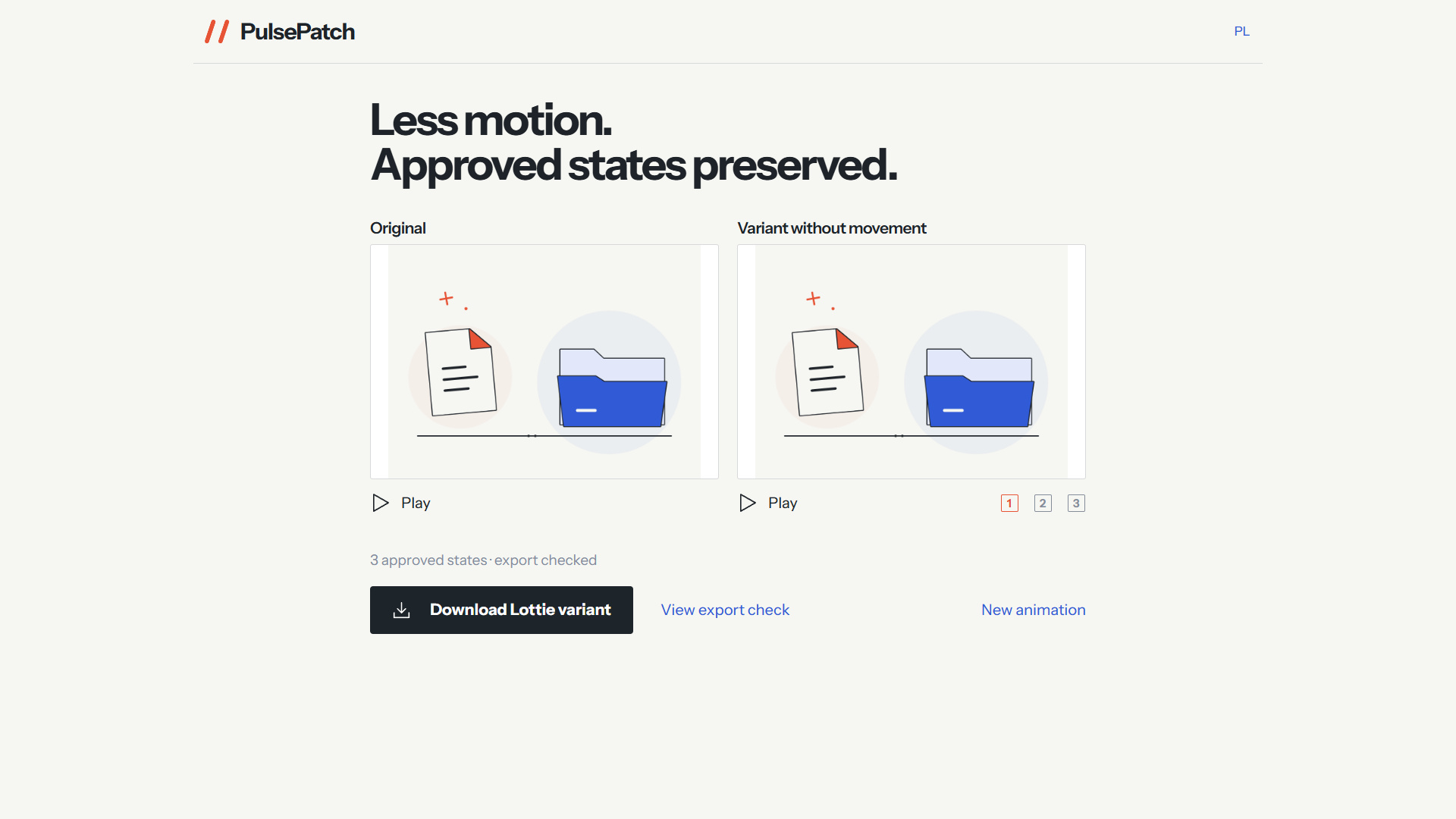
Actual recorded engine 216 result: the original and three approved states, retained as editable vectors.
Your intention. Your approval. Your file.
01
Bring the original
Upload your supported animation and describe what the viewer needs to see.
02
Choose what to keep
Inspect the proposed images and their order. Revise when needed, then approve this exact choice.
03
Keep editing
Download an editable static or hold-only Lottie, an approved-state record and an export report. Keep the original too.
What I choose to leave.
Recorded engine 216 workflow · Updated release 218 report · 2 min 25 sec · dramatized campus and designer scenes · AI voice Melissa · actual recorded PulsePatch UI and export. The student’s request is fiction; an AI operator performed the recorded run. Transcript · Captions
Supporting technical walkthrough — engine 216
115.4 seconds · original technical demonstration · burned-in English captions. Technical transcript.
A proposal you can inspect.
A final pose can leave out an earlier state the author wants to show. PulsePatch connects the brief, actual rendered images, author approval and a saved vector artifact. Manual editing can produce the same result; comparative usefulness remains unmeasured.
In the recorded run, OpenCV rejected a proposed confirmation state as transitional. That physical feedback reached a later model decision. An AI operator inspected and approved the revised states; the saved export passed all eight checks.
In a small synthetic study, adaptive produced six correct outcomes—four exports and two appropriate author questions—versus four for one-pass. The registered advantage rule failed. The cases, operation and assessment were AI-based; human understanding and author time were not measured. The full paired results and limitations are in the report.
The eight checks concern the approved editable export contract, including freshly rendering the exact saved file. They do not establish whether a viewer understands it. A held state has a finite exposure; this workflow does not promise viewer-controlled steps or an indefinite pause.
The selected public 216 demonstration is development evidence, not a new holdout. The earlier failed public 215 take remains preserved. Release 218 adds the optional Guide, clearer reporting and explicit software identity, with separate engineering tests. The accepted film and downloads retain their recorded 216 identity. Market demand and a business model remain unvalidated hypotheses.
Before you upload
The interface and rendering/measurement service run on AWS. Selected actual images and bounded context go to the external Anthropic API; credentials stay server-side. Use material you may send. Application jobs and artifacts persist until operator removal, with no self-service deletion endpoint. Provider file expiry is separate from application retention.
Created by Damian Karolewski with AI coding assistants. For project or stored-material questions, use the author’s Devpost profile.